

Food For Thought – Charlene Pardo
September 2025
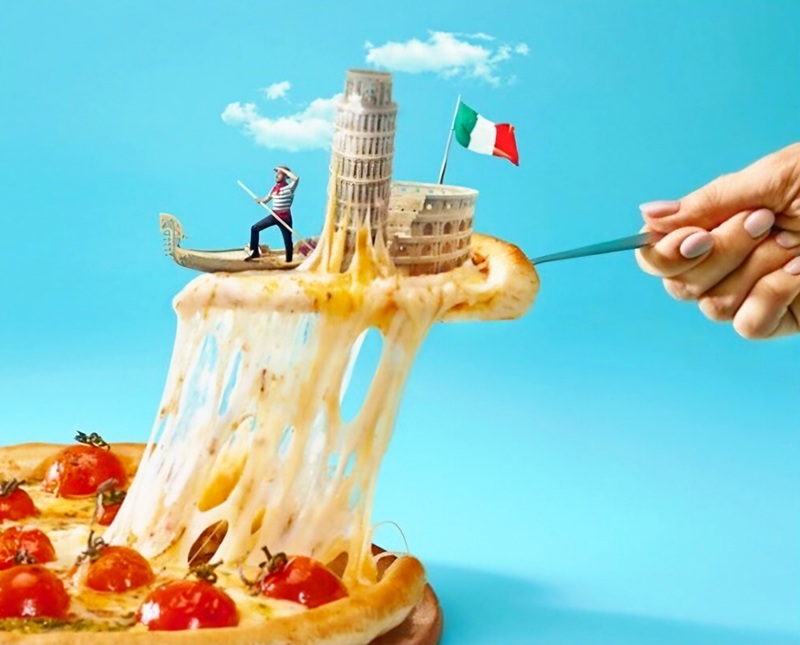
As we know from our own experience, Italian food has always brought family and friends together. Our food has traditionally been one of the strongest cultural links between Italy and America. To honor this tradition, here are three famous food stories you might not have heard before:
In 1927, American movie stars Mary Pickford and Douglas Fairbanks were on their honeymoon in Rome. Every night this elegant couple would dine at Alfredo’s restaurant and order “Fetuccine al Buro” a dish made with pasta, cream, and butter. When the honeymooners returned to Hollywood, they shared the recipe with their famous friends, but they renamed the dish “Fettuccine Alfredo” in honor of the chef who created it. Since then, the dish has become a popular menu item in many Italian restaurants.
The story of “Spaghetti alla Carbonara” traces back to the last days of World War II. American soldiers started sharing their rations of bacon and eggs with the Italians they had just liberated. The Italians added pasta to the mix and Spaghetti alla Carbonara was born. The combination of eggs, cheese, pork, and pasta has become a delicious addition to our cuisine.
And finally, in the 1965 movie “The Agony and the Ecstasy”, American actor, Charlton Heston portrays the Italian artist, Michelangelo. In the famous scenes where Michelangelo is painting the ceiling on his back from a scaffolding, wet brown plaster is dripping onto his face and into his mouth. Luckily for Mr. Heston, the plaster was actually that favorite American snack, chocolate pudding!
As you can see from these examples, food continues to connect us to our Italian roots. Please enjoy the chocolate pudding provided for tonight’s dessert. I hope you will think of poor Michelangelo every time you eat chocolate pudding. Please feel free to take some pudding home. Buon appetito!
Source:
Little Known Facts About Well-Known Places: Italy, by David Hoffman. Metro Books, New York: 2008.
Do You Know Latin? – Charlene Pardo
August 2025
 Italian culture has always contributed great art, music, architecture, food and wine to the world. Yet one major contribution from Ancient Rome has gone mostly unappreciated in modern times and this is the Latin language. Although Latin is considered a “dead” language, Latin gave birth to Italian, Spanish, French, Portuguese, Catalan, and Romanian before it died. The Romans made Latin the official language of the countries they conquered. Then Latin slowly evolved into the Romance languages of Western Europe that these countries speak today.
Now, only one country in the world has Latin as one of its official languages and that is Vatican City. All papal documents are written first in Latin and then translated into other languages. There are still Latin prayers and services in some Catholic Churches, and some Catholic and private schools still teach Latin, which seems to boost their students’ ACT and SAT verbal scores.
You may not think Latin influences us now, but about 55% of English words have Latin roots, which includes the French and Spanish contributions.
The main areas of Latin influence are found in the medical, scientific, and legal professions. Precisely because Latin is a “dead” language, the meanings of the words don’t change and are not subject to modern interpretations. Think of the legal terms you have heard, such as “subpoena”, “affidavit”, “status quo”, “alibi”, “postmortem”, and “habeus corpus” whose definitions never change.
Think of how often you use the words “et cetera” (etc.), which means “and the other things” even when you don’t remember what the other things are. A very common and useful phrase! You would be surprised at how many other Latin words you know and use every day.
The medical profession also relies on Latin names for many diseases and parts of the body. The words “arthritis”, “anemia” and “cancer” are all Latin words with no English translation, yet we understand what they mean. Your doctor probably favors the Latin names for body parts and calls your collarbone a “clavicle” and your skull a “cranium”. If you break your leg, the doctor uses purely Latin words to tell you if it was your “femur”, your “tibia”, or your “fibula” that broke. And you already know what a “patella” is if you’ve had your knees replaced.
Scientists use Latin nomenclature to identify plant and animal species. Most labels on plants and seed packages still print their full Latin names just to make sure you get the right one. When a new animal or plant species is discovered, scientists, under some strict guidelines, have fun giving them a Latin name. For example, I can’t imagine calling a tyrannical lizard king anything but Tyrannosaurus Rex. His Latin name fits him perfectly.
So the next time a doctor, lawyer, or scientist starts talking over your head, remember that in order to confuse you in Modern English, they first had to learn our ancestral language, Latin.
And finally, when you look up at the stars tonight, know that our Roman ancestors named the constellations you see, such as “Sagittarius”, “Taurus”, “Leo”, “Gemini”, “Pisces”, et cetera.
Then I hope you will begin to realize that we are still speaking their language!
Limoncello – Charlene Pardo
June 2025

It’s summertime and thousands of Italians are enjoying a cool, classic summer drink called limoncello. Authentic limoncello is made with only four ingredients: organic lemon zest, alcohol, water, and sugar.
The name “limoncello” is not protected by law, so unscrupulous companies can sell a product that veers from this original recipe.
Although modern producers might add artificial coloring or flavors, their creation can no longer be labeled Italian limoncello as of 2008. If the label doesn’t have a “Protected Geographical Indication” (PGI), the official seal of authenticity, then it’s not real limoncello. Buyer beware!
Limoncello was traditionally poured at room temperature, but now it’s usually served ice cold as a refreshing break from the summer heat. Limoncello-flavored gelato, cookies, and cakes are also popular summertime treats.
Although there’s not a lot of historical evidence for the origins of limoncello, folklore and controversy abound. Generally, Italians agree that the drink originated somewhere along the Amalfi Coast, either in Almalfi, Sorrento, or the island of Capri. Of course, each one of these places calls itself the “Birthplace of Limoncello”, so its history remains ridiculously controversial.
Amalfi claims that their sweet “Sfusato” lemons have been making traditional limoncello for a thousand years, but without documentation, this claim is hard to back up.
On the other hand, the citizens of Sorrento insist its organically grown “Sorrento” lemons are just as sweet as Amalfi’s and they have written records going back to 1656.
Capri, the third contender, has the most recent claim, but it’s the most well-documented and has the approval of the Italian Association of Wine and Liqueur. And so, the rivalry continues!
Regardless of its origins, limoncello continues to be enjoyed by Italians and Americans alike. May its refreshing, lemony taste brightens your summer.
Sources:
www.florenceinferno/limoncello